During the filming process, we found that we had more room to perform the diverse range of shots and angles that we have included in our storyboards. We found that we kept more to our filming schedule and no arguments were generated unlike the previous filming attempts.
After we felt we had successfully flmed all the shots we planned to film, we uploaded our footage on to the Mac computers for editing. After a quick analysis of the general quality of the footage we could already tell that the images were much clearer and of better standard compared to our previous attempts on the last filming session. This was mainly due to the fact that we were filming indoors and had access to artificial lighting.
We began to piece together and select the clips that we wanted to include in our opening. We found it difficult to choose between clips that were taken two or three times which looked very similar but we usually came to a mutual decision on which was the best.
The clips quickly began to flow together as we added music to the background. We had to find a piece of music on the internet which was free to use and not copy righted. It took us a while to precisely trim the beginnings and ends off of clips and scene that were unnecessary but once we completed that we went on to the titles.
After our initial storyboard planning we already had a good idea of where we wanted our titles to go. The hardest bit of the editing process, I felt, was choosing the fonts, transitions and positions for titles as this is the opening sequence the title specifics are an important part of each scene.
We decided to use "New Line Cinema" as our main production company, this was because during our research we found that a lot of thrillers or similar films to our plot had been created by New Line Cinema. It also made our opening look more professional and realistic.
Thursday, 11 February 2010

Significant Developments in the Thriller Genre
A big development that has affected films recently is the investment towards 3D motion pictures. Aided by special glasses, the films enhance the illusion of depth perception by using a special motion picture camera that records the footage as it is seen from two perspectives. 3D films have existed in forms since 1890s but with recent dynamic developments in digital media and high definition imagery, 3D films are becoming more advanced, more realistic and more spectacular. In some respects this can be seen as a bad thing as film makers are spending less attention to detail when writing the story then when they are making it, the storyline could become less imaginative than it could be. Seeing as these are relatively new developments people will still go and watch the film even if they normally wouldn't be that interested in the genre, just to see the 3D motion. This can be shown with recently released films such as The Final Destination 3D (Final Destination 4) which earned $27.4 million in the first weekend even though it had bad reviews from movie critics who were more interested in the story than the imagery.
Another big development is the use of CGI (Computer Generated Imagery) this is used for visual effects, usually because it's more controllable to create graphics on the computer such as explosions or gun fire. It can also be used to add crowds in the background, which can be shown in the film "300" where 300 men fight a whole Persian army, instead of hiring masses of people, the majority of soldiers shown were actually generated on the computer using green screen technology or chroma keying. This is where two images or frames are mixed together in which a colour is removed or made transparent to reveal another frame or picture behind it, making it seem as though it is in the same scene.
Recent developments in the quality of digital media, as with 3D footage, has meant that CGI effects have become more realistic and also more subtle, sometimes you may not even notice an effect but with out it the scene would not be the same. It has affected Sci-Fi and fantasy genres greater than Thriller films as they can portray characters, objects and actions which aren't possible in real life to perform.
Another big development is the use of CGI (Computer Generated Imagery) this is used for visual effects, usually because it's more controllable to create graphics on the computer such as explosions or gun fire. It can also be used to add crowds in the background, which can be shown in the film "300" where 300 men fight a whole Persian army, instead of hiring masses of people, the majority of soldiers shown were actually generated on the computer using green screen technology or chroma keying. This is where two images or frames are mixed together in which a colour is removed or made transparent to reveal another frame or picture behind it, making it seem as though it is in the same scene.
Recent developments in the quality of digital media, as with 3D footage, has meant that CGI effects have become more realistic and also more subtle, sometimes you may not even notice an effect but with out it the scene would not be the same. It has affected Sci-Fi and fantasy genres greater than Thriller films as they can portray characters, objects and actions which aren't possible in real life to perform.
Wednesday, 10 February 2010
Target Audience and How we Intend to Appeal to Them
We decided that our target audience would be teenagers to middle aged adults, probably giving our film of a UK rating of 15. This is because we think that our plot is one that teenagers can associate with as it could happen to them or someone they know and we feel it could be an eye opener for them. However, we also felt that it was both intriguing and inspiring enough to appeal to an adult audience.
Monday, 8 February 2010
Institutions Producing Thriller Genres
New Line Cinema
This production company was founded in 1967 and is a subsidiary of Warner Bros. Entertainment, therefore making it a part of one of the major American film studios. "A Nightmare on Elm Street" was New Lines first successful series, even though that is more of a horror than a thriller the company has also produced quite a few successful thriller/suspense films. These include:

Newmarket Capital Group
This production company was founded in 1994 by William Tyrer and Chris Ball and has grown from a private film finance to one of the leading producers and distributors of films in the world. It has produced many thrillers such as Donnie Darko, Prom Night and Memento. They have also Distributed major film releases such as "The Passion of the Christ" which had a total lifetime gross of $611, 899, 420 worldwide.

This production company was founded in 1967 and is a subsidiary of Warner Bros. Entertainment, therefore making it a part of one of the major American film studios. "A Nightmare on Elm Street" was New Lines first successful series, even though that is more of a horror than a thriller the company has also produced quite a few successful thriller/suspense films. These include:
- 15 Minutes
- Se7en
- A Man Apart
- Birth
- Willard
Newmarket Capital Group
This production company was founded in 1994 by William Tyrer and Chris Ball and has grown from a private film finance to one of the leading producers and distributors of films in the world. It has produced many thrillers such as Donnie Darko, Prom Night and Memento. They have also Distributed major film releases such as "The Passion of the Christ" which had a total lifetime gross of $611, 899, 420 worldwide.
Wednesday, 27 January 2010
Second Filming Process and Decision To Change
Decision To Change - After filming a second time using a floodlight, to improve the quality and lighting of the footage, we uploaded the tape on to the computers. We found that the flood lights had made a vast improvement on the quality of footage and you were able to see characters and objects clearer, instead of the dark "grainy" footage we had before. The group then began to edit the clips and put the story together.
As this time we edited was after I had carried out deep analysis on many film opening sequences and whole films I felt that we had got the wrong impression and had been swayed off task. When we told to make a "Thriller Opening" we immediately tried to fit the the whole plot and storyline in to that 2 minute limit, in other words we tried to do too much and tried to make a thriller film rather than a thriller opening. For example: I felt that there was too much dialogue, there was no enigma being created, we didn't follow the story boards so much footage wasn't correct or not of good standard, the lighting was still dark or very bright in different shots and we were putting transitions in between shots so we could cut down on the amount of footage to squeeze in to the time limit. Also, because of these criticisms I was making, I wanted to dictate part of the editing process in order to correct these problems, which wasn't fair on the rest of the group especially as some didn't agree.
For these reasons I knew it would be wrong to force the group to change features of the project to my liking and so me and another member of our group decided to detach and create our own project.
As this time we edited was after I had carried out deep analysis on many film opening sequences and whole films I felt that we had got the wrong impression and had been swayed off task. When we told to make a "Thriller Opening" we immediately tried to fit the the whole plot and storyline in to that 2 minute limit, in other words we tried to do too much and tried to make a thriller film rather than a thriller opening. For example: I felt that there was too much dialogue, there was no enigma being created, we didn't follow the story boards so much footage wasn't correct or not of good standard, the lighting was still dark or very bright in different shots and we were putting transitions in between shots so we could cut down on the amount of footage to squeeze in to the time limit. Also, because of these criticisms I was making, I wanted to dictate part of the editing process in order to correct these problems, which wasn't fair on the rest of the group especially as some didn't agree.
For these reasons I knew it would be wrong to force the group to change features of the project to my liking and so me and another member of our group decided to detach and create our own project.
NEW Plot Description
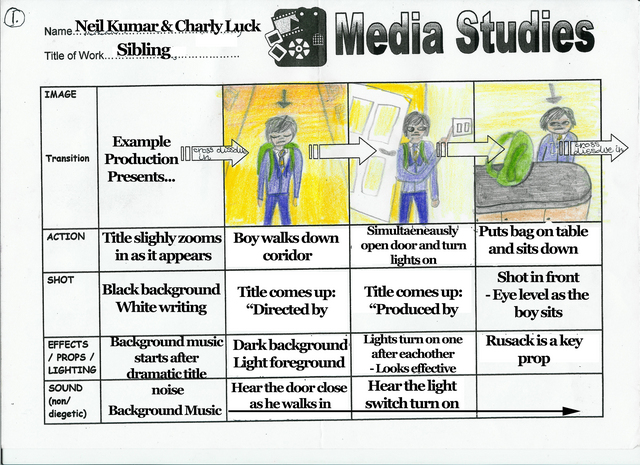
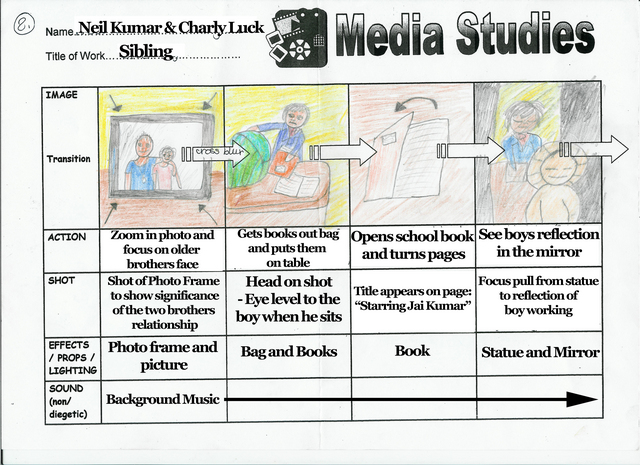
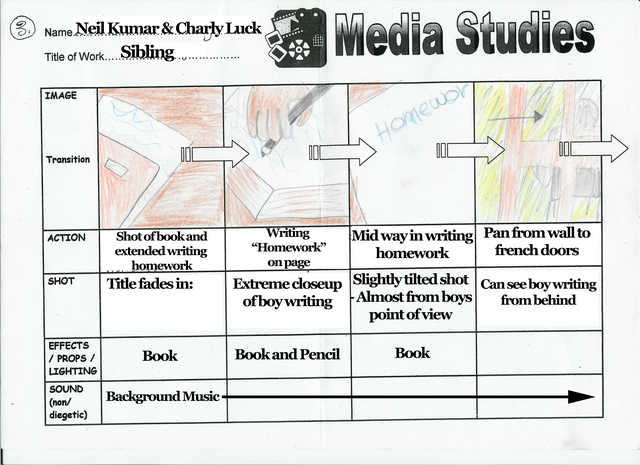
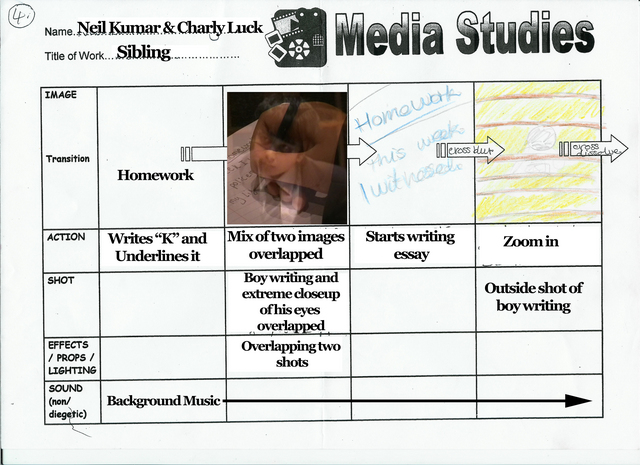
Our new plot, we felt, is different from the majority choice. As we learnt from previous filming, the opening sequence does not need to include many, if any, scenes of the main plot. With this in mind we didn't include any scenes including the main plot, as much of it actually takes place before the time that the opening sequence is set in.
Plot (Before opening sequence) - A boy witnesses his older brother getting shot and being killed by a police officer in the crossfire of a shoot out between a criminal and a police force.
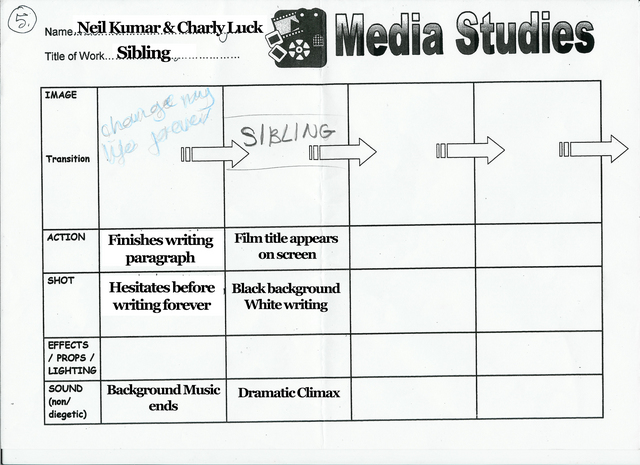
Opening Sequence - This is set after those events have taken place as the younger brother arrives home from school a week later and is given an extended writing homework assignment to write about events occurring in the last week and how they have affected him, as he witnessed his brothers death, that week had affected him deeply and would probably be remembered forever.
Main Plot (After opening sequence) - After the opening sequence, the audience would eventually find out what it is that the younger brother witnessed because as a result the he grows up with a hatred for authority, especially police force, turning to crime and revolution.
Plot (Before opening sequence) - A boy witnesses his older brother getting shot and being killed by a police officer in the crossfire of a shoot out between a criminal and a police force.
Opening Sequence - This is set after those events have taken place as the younger brother arrives home from school a week later and is given an extended writing homework assignment to write about events occurring in the last week and how they have affected him, as he witnessed his brothers death, that week had affected him deeply and would probably be remembered forever.
Main Plot (After opening sequence) - After the opening sequence, the audience would eventually find out what it is that the younger brother witnessed because as a result the he grows up with a hatred for authority, especially police force, turning to crime and revolution.
NEW Planning of Locations and Why Chosen
We knew that we wanted our opening to be filmed inside because its almost essential to the plot and we would eliminate lighting difficulties that we had encountered in previous experiences. Our two main options to use for the set our of project were:
- At School - In a Classroom
- A House - At a Table/Study
- Showing the boy in school uniform at home meant that we could still capture the schoolboy character in a scene were he is meant to be relaxed but in reality he is shown to be distressed and depressed rather than relaxed. This way we can express a contrast which is an element that I have noticed in many thriller films.
- There is a corridor, table and enough room in my house to correspond to the shots that we have included in the storyboard
- We have more control over the lighting as there are light switches that control different areas of lighting on the ceiling meaning we can lighten or darken certain areas of the shot.
- It is easily accessible as both of us live in Hitchin, this was a big problem we had before as the filming took place in Codicote and buses only run at certain hours. Also, it was difficult getting everyone together to film to travel there.
Planning of Characters/Actors and Why Chosen

We wanted our thriller to be different from the usual, predictable films and therefore we knew that our characters had to reflect that. We wanted our main character to be psychologically complex coming from a harsh but believable background.
The opening scene is set when the character is still young and before he develops in to the main character later in the film. We wanted to capture the innocence and hit the audience with a dramatic start which really sets the scene and expresses how the character is feeling and how badly it has affected him.
We knew we needed a young male actor to star in our opening, we also knew that we needed him to be readily available on the dates that we were able to attend. As i had learnt from previous filming experience were we found it difficult to get the actors together as members of the group had claimed they had informed the chosen actors on the dates but finding out on the day that the actors were unavailable.
Me and my other group member decided that my younger brother would be a good person to play the part as he young and willing to do it. Also, he wouldn't have to travel to the destination as we were filming the opening at our house, this meant that he is readily available on most days. We used his school uniform, school bag and school books, this added "mundane realism" to our film as the clothes and props were actually used in real life in the same situation in which our character would of.
Brainstorm of Ideas for the Title
For the film title we wanted a simple, but effective word that people can pronounce. We particularly liked the titles "Memento", "Vertigo" and "Se7en". This was when we decided that we wanted our title just to be one word(not include the word "the") and related to family or relationship.
After much consideration we got down to three titles:
"Retribution"
"Sibling"
"The Reprisal"
We decided to gain feedback from our target audience, which our class was a part of. We did a quick test using a focus group of only a few people on our table, this can be seen in the poll in the top right hand corner.

After much consideration we got down to three titles:
"Retribution"
"Sibling"
"The Reprisal"
We decided to gain feedback from our target audience, which our class was a part of. We did a quick test using a focus group of only a few people on our table, this can be seen in the poll in the top right hand corner.

The general favourite was the title "Sibling" as it fits in well with the plot and it is a simple word that is still effective.
To test this feedback we carried out a survey of around 30 people, they were given a tally chart where they could choose which one they liked best. We used people from our media class and another media class to gain this feedback as they would be the majority of our target audience.
We plotted our results in Microsoft Exel and converted them in to a pie chart that could easily be interpreted: The green portion represents the title "Sibling", the red "The Reprisal" and the blue "Retribution".
As you can see Sibling was the most favored choice and so we decided to stick with this title. After analysing the options we also decided to have the title in capitals such as: "SIBLING" this gives it more of a dramatic effect.
To test this feedback we carried out a survey of around 30 people, they were given a tally chart where they could choose which one they liked best. We used people from our media class and another media class to gain this feedback as they would be the majority of our target audience.
We plotted our results in Microsoft Exel and converted them in to a pie chart that could easily be interpreted:
 The green portion represents the title "Sibling", the red "The Reprisal" and the blue "Retribution".
As you can see Sibling was the most favored choice and so we decided to stick with this title. After analysing the options we also decided to have the title in capitals such as: "SIBLING" this gives it more of a dramatic effect.
Monday, 25 January 2010
Directors from the Genre - Martin Scorsese
Martin C. Scorsese (born November 17, 1942), the founder of the World Cinema Foundation, is an American film director, screenwriter, producer, actor and film historian. He grew up during the Vietnam War and did not serve as he struggled with asthma throughout childhood. This is said to have an influence on one if not more of his films, including the darkly comic "The Big Shave" in 1967, which is a negative representation of this war, suggested by it's alternative title "Viet '67".
Even from the early days, a "Scorsese Style" was becoming evident; New York Italian American street life, rapid editing and a eclectic rock soundtrack. During the 1970s he befriended many influential people in the film industry, Francis Ford Coppola, Brian De Palma, George Lucas, Steven Spielberg and was introduced to Robert De Niro.
Scorsese had many director trade marks that he used throughout his films. These include begining the film was segments from the middle or the end. He frequently used slow motion or freeze frames - this is were the image on screen stops and becomes a still picture. His lead characters were often sociopathic or wanted to be accepted by society and the lead women characters are normally shown as "angelic" through the eyes of the protaganist. He also used MOS sequences to put over popular music or a voice over, usually involving rapid camera movement.
Even from the early days, a "Scorsese Style" was becoming evident; New York Italian American street life, rapid editing and a eclectic rock soundtrack. During the 1970s he befriended many influential people in the film industry, Francis Ford Coppola, Brian De Palma, George Lucas, Steven Spielberg and was introduced to Robert De Niro.
Scorsese had many director trade marks that he used throughout his films. These include begining the film was segments from the middle or the end. He frequently used slow motion or freeze frames - this is were the image on screen stops and becomes a still picture. His lead characters were often sociopathic or wanted to be accepted by society and the lead women characters are normally shown as "angelic" through the eyes of the protaganist. He also used MOS sequences to put over popular music or a voice over, usually involving rapid camera movement.
Monday, 18 January 2010
Directors from the Genre - Alfred Hitchcock
Sir Alfred Joesph Hitchcock (13 August 1899 – 29 April 1980) was a English filmmaker and producer who created many suspense techniques in the psychological and thriller genres. He created over 50 films in six decades, mostly being silent films.
He seemed to enjoy the technical challenges of film making, for example in the film Lifeboat he staged the entire action of the movie in a small boat and yet managed to keep the production from benig monotonous.
Hitcock has a strong visual mind and would visualize the picture right down to the final cuts, he would then write this out in great detail in the script and then doesn't need to refer to the script when filming as he already knows it off by heart. He also said that when you've finished the script the film is perfect but in filming you loose at least 40% of the original concept.
While he did do a great deal of preparation, he did understand that the actual film making process often deviated from even the best laid plans and that his films wern't free from the normal hassles that production faces.
Alfred Hitchcock did not tolerate the "method approach" this is where the actors try to create themselves in to the thoughts and emotions of the characters, this helps them produce a "lifelike" performance, Hitchcock said that the actors should only concentrate on their performances and leave the script and character to the directors. He believed that the method actor was ok in theatres because they have free space to move around but when it comes to cutting the face of the actor and using shots of what they see, there has to be some discipline.
Hitchcock frequently used a technique called a "McGuffin" this is a device or plot element that catches the viewer's attention or drives the plot, it is something the whole plot is built around but has no real relevance to the story. For example the "All Spark" in Transformers, it could of been anything but it is the device that drives the storyline.
Towards the end of his life he worked on a the script for a spy thriller film, even though he had done some preliminary work, the movie was never filmed this was due to his own failing health. Alfred Hitchcock died from kidney failure in his home in California at the age of 80.
He seemed to enjoy the technical challenges of film making, for example in the film Lifeboat he staged the entire action of the movie in a small boat and yet managed to keep the production from benig monotonous.
Hitcock has a strong visual mind and would visualize the picture right down to the final cuts, he would then write this out in great detail in the script and then doesn't need to refer to the script when filming as he already knows it off by heart. He also said that when you've finished the script the film is perfect but in filming you loose at least 40% of the original concept.
While he did do a great deal of preparation, he did understand that the actual film making process often deviated from even the best laid plans and that his films wern't free from the normal hassles that production faces.
Alfred Hitchcock did not tolerate the "method approach" this is where the actors try to create themselves in to the thoughts and emotions of the characters, this helps them produce a "lifelike" performance, Hitchcock said that the actors should only concentrate on their performances and leave the script and character to the directors. He believed that the method actor was ok in theatres because they have free space to move around but when it comes to cutting the face of the actor and using shots of what they see, there has to be some discipline.
Hitchcock frequently used a technique called a "McGuffin" this is a device or plot element that catches the viewer's attention or drives the plot, it is something the whole plot is built around but has no real relevance to the story. For example the "All Spark" in Transformers, it could of been anything but it is the device that drives the storyline.
Towards the end of his life he worked on a the script for a spy thriller film, even though he had done some preliminary work, the movie was never filmed this was due to his own failing health. Alfred Hitchcock died from kidney failure in his home in California at the age of 80.
Sunday, 17 January 2010
The Killing Room
The films title is very bold "The Killing Room" suggests a room in which killing takes place, which is basically what happens but not as simple as mindless slaughter, the plot is quite complex and so I think the title should be as witty as the storyline.
The first few scenes are built up of rapid shots, these shots act as a "catchup" to enlighten the audience on all the events that have taken place up until this point, which is the point where the films starts and the main plot begins. A sense of enigma is created why are they locked in a room? what is the meaning of the strange questions they have been asked?
The immaculately clean, plain white walls of the room and the metallic tables and chairs that are bolted to the floor give a sense of some sort of experiment that seems ethically wrong, it gives the stereotype of evil scientists in white coats and face masks on. The quick shots in the main plot give a sense of urgency, this engages the viewer and helps that feel the affects of the characters situation. Actions such as the breaking of a pencil which is small, but significant because it also emphasises the characters emotions.
The dark, shadowy atmosphere in this thriller is contrasted significantly with the bright white, sinister room. The people watching down on to the "experiment" room are in a dark room above with black tinted windows which only looks out one way. This gives the effects that that the dark and evil people are watching down on the innocent people.
The mood is established with the shots of the metal chairs and bolted tables, this gives the sense of no escape. Also, the sounds of foots coming from the heels of smart shoes - ones that a doctor would wear, add to the effect that they are being experimented on.
At some points in the film joyful or happy music is played and sometimes old fashioned lullaby music, this gives an eerie effect because it is out of context.
The first few scenes are built up of rapid shots, these shots act as a "catchup" to enlighten the audience on all the events that have taken place up until this point, which is the point where the films starts and the main plot begins. A sense of enigma is created why are they locked in a room? what is the meaning of the strange questions they have been asked?
The immaculately clean, plain white walls of the room and the metallic tables and chairs that are bolted to the floor give a sense of some sort of experiment that seems ethically wrong, it gives the stereotype of evil scientists in white coats and face masks on. The quick shots in the main plot give a sense of urgency, this engages the viewer and helps that feel the affects of the characters situation. Actions such as the breaking of a pencil which is small, but significant because it also emphasises the characters emotions.
The dark, shadowy atmosphere in this thriller is contrasted significantly with the bright white, sinister room. The people watching down on to the "experiment" room are in a dark room above with black tinted windows which only looks out one way. This gives the effects that that the dark and evil people are watching down on the innocent people.
The mood is established with the shots of the metal chairs and bolted tables, this gives the sense of no escape. Also, the sounds of foots coming from the heels of smart shoes - ones that a doctor would wear, add to the effect that they are being experimented on.
At some points in the film joyful or happy music is played and sometimes old fashioned lullaby music, this gives an eerie effect because it is out of context.
Subscribe to:
Comments (Atom)